Global IT supply chain
International transportation + IT O&M outsourcing + self-owned backbone network
In the wave of digital transformation in the financial industry, network architecture has always been the lifeline supporting the operation of core businesses. Whether it is real-time transactions for banks, high-frequency market data delivery for securities firms, or cloud-based underwriting systems for insurers, extremely high business continuity and strict data compliance baselines place extraordinarily high demands on enterprise WANs.
For a long time, MPLS private lines have been regarded as the "gold standard" of financial network architecture due to their deterministic low latency and strict SLA quality assurance. However, with the acceleration of smart bank branch construction and the widespread adoption of hybrid cloud architectures, traditional private lines are facing unprecedented challenges: branch traffic is growing exponentially, and relying solely on expanding MPLS private lines will cause IT budgets to spiral out of control; at the same time, in the traditional "primary/backup dual private line" model, the backup line remains idle for long periods, resulting in serious waste of capital and resources.
Faced with this dilemma, IT decision-makers at financial institutions do not need to blindly tear everything down and start over. Given massive existing assets and strict security and compliance red lines, the most rational and efficient path for upgrading financial network architecture is to use SD-WAN to empower the existing network and build an MPLS hybrid network (Hybrid WAN).
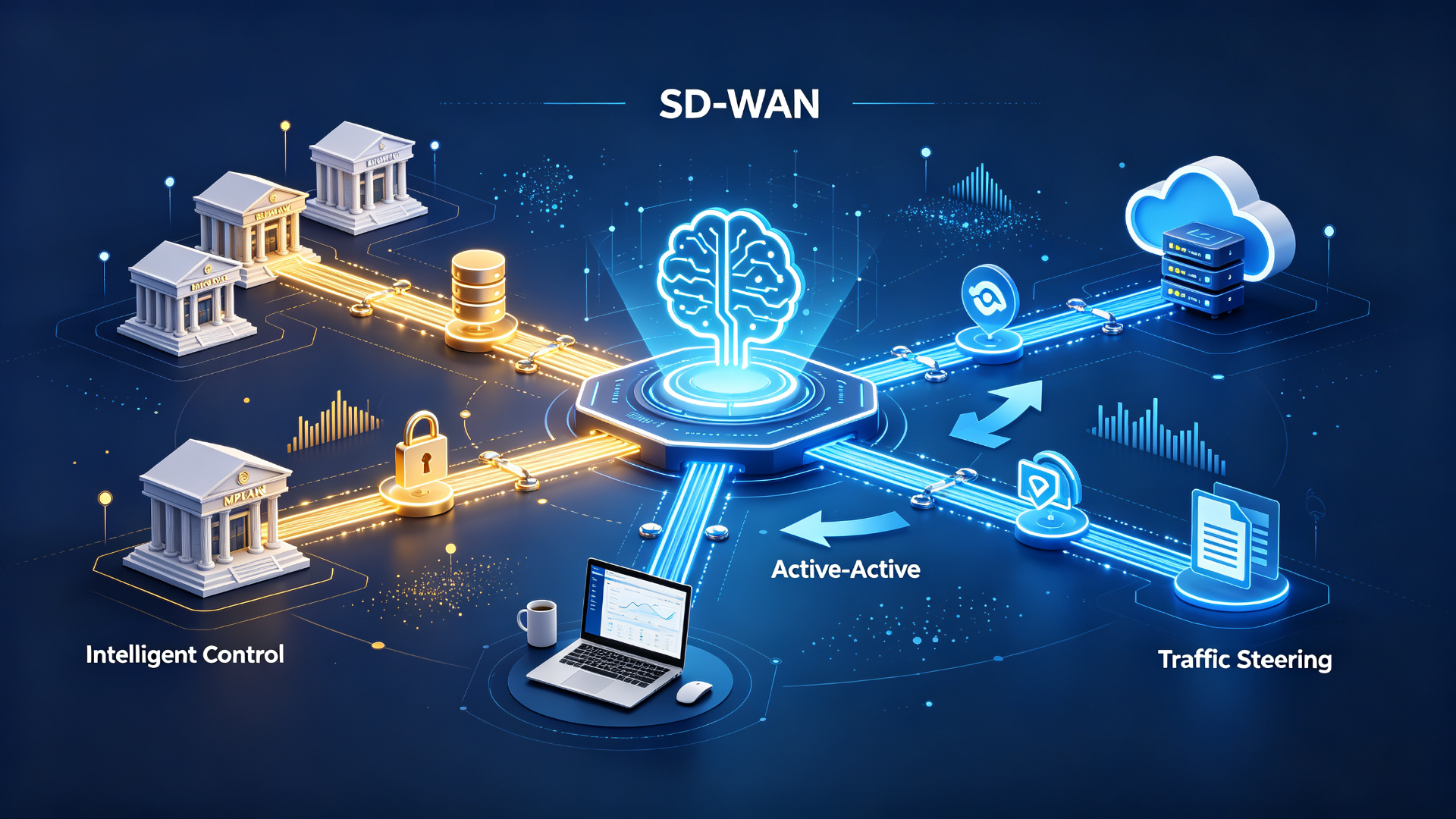
In traditional financial WANs, MPLS private lines are more like fixed pipelines, lacking awareness of upper-layer application traffic and dynamic scheduling capabilities. By overlaying a financial-grade SD-WAN control layer (Overlay architecture), enterprises can give the WAN powerful intelligent capabilities without changing existing physical links:
Traditional financial networks usually adopt a "primary/backup" private line model, where the backup link is switched over via routing protocols only when the primary link fails completely, and the switchover process is often accompanied by second-level or even minute-level jitter. Through an MPLS hybrid network, SD-WAN can upgrade the "primary/backup" model to an "active-active" scheduling model. SD-WAN can sense link quality in real time, detecting packet loss, latency, and jitter. When the primary private line degrades in quality, the system can automatically switch to the backup link, ensuring continuity of core business.
Using SD-WAN application identification and traffic scheduling capabilities, financial institutions can precisely classify different business traffic. Highly sensitive services such as Core Banking, real-time database synchronization, and others continue to remain on high-quality MPLS private lines, while high-definition video surveillance, internal office, AI dual recording, and cloud SaaS traffic are offloaded to heavily encrypted SD-WAN internet links. This financial private line optimization solution not only safeguards the bottom line for transmitting core data but also alleviates the pressure of private line expansion.
Under the traditional model, building a new bank branch or connecting to a public cloud/financial cloud requires a lengthy private line deployment and approval cycle, often taking months. SD-WAN supports zero-touch provisioning (ZTP). Branch offices only need to plug in the device and connect to the internet, and through a unified cloud orchestration platform, a secure encrypted tunnel can be established in as little as five minutes, shortening the cycle for connecting bank branch networks with the financial cloud to a few days and greatly improving business agility.
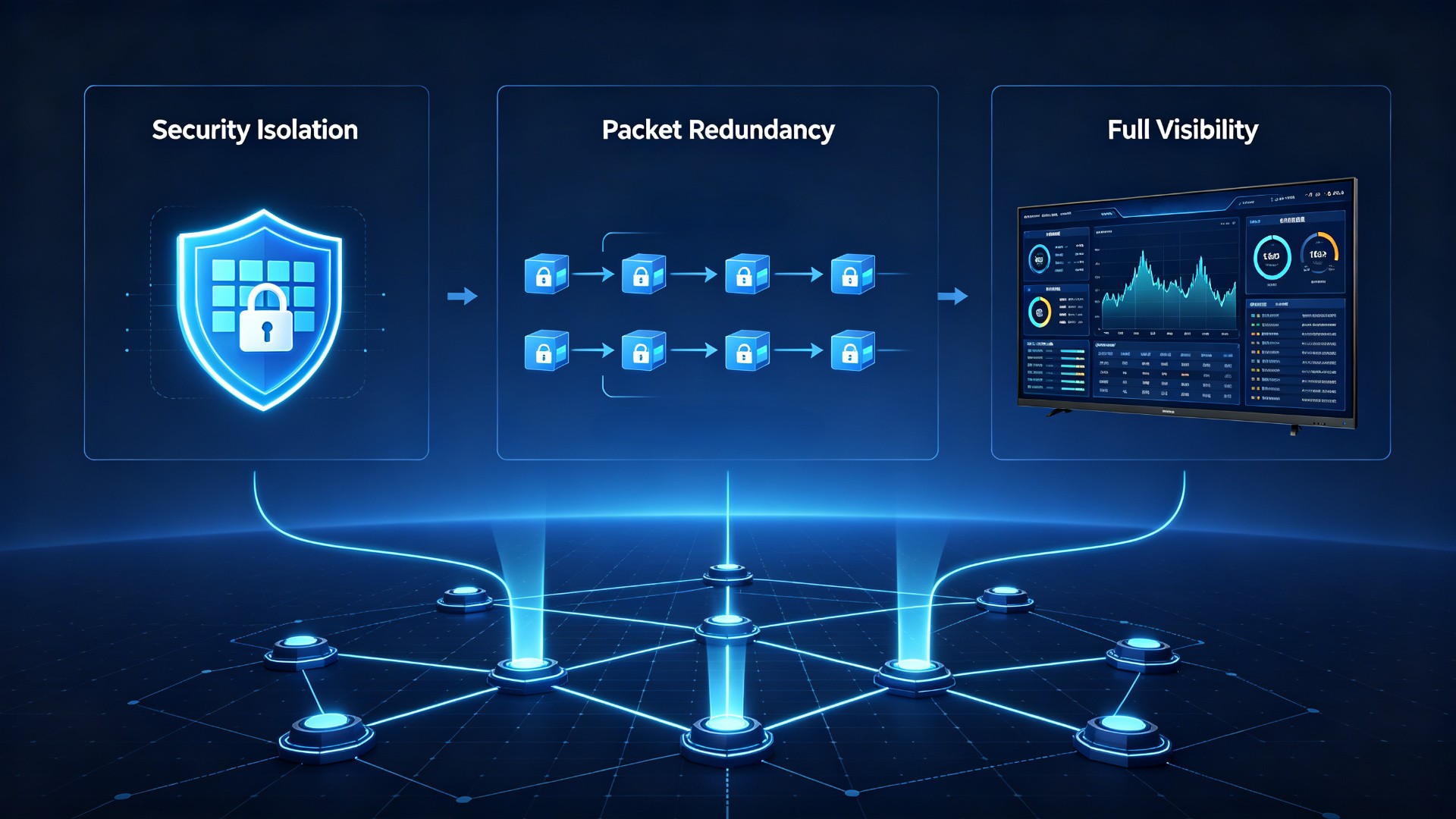
Although SD-WAN brings significant flexibility and cost advantages, the unique nature of the financial industry means its evaluation criteria for financial-grade SD-WAN are far higher than those for ordinary enterprises. When planning a hybrid network, the following three bottom lines must be strictly maintained:
Upgrading network architecture cannot come at the expense of security. A financial-grade SD-WAN solution should provide transmission encryption and network security protection capabilities, and feature network segmentation and access control mechanisms to help achieve logical isolation among the core production network, office network, guest network, and endpoint devices, so as to comply with financial institutions' network security and audit requirements.
For scenarios that are extremely sensitive to latency and jitter, such as high-frequency securities trading and market data broadcasting, WAN devices need to support "packet duplication" for critical packets. Even if a sudden packet loss occurs on one line, the system can compensate in real time over another link, ensuring that the business layer remains unaware.
The headquarters IT management team needs a global view of link quality, application traffic distribution, and security events across all branch nodes in the entire network. The centralized management console should provide visualized SLA monitoring metrics and be able to export log reports that meet financial regulatory audit requirements.
As a professional service provider focused on cloud-network convergence and enterprise-grade networking, OgCloud deeply understands financial institutions' need to balance "stability, security, and cost-effectiveness" in networks. The OgCloud financial-grade SD-WAN solution is designed to help financial customers achieve a smooth financial network architecture upgrade without undermining existing investments.
● Protect Existing Assets and Overlay Smoothly and Quickly:
OgCloud supports overlay mode on financial institutions' existing MPLS private lines and network devices. Without changing the underlying network topology, it enables a smooth transition from traditional private lines to an intelligent MPLS hybrid network.
● Backbone Node and Transmission Link Assurance:
Based on OgCloud's domestic backbone POP node resources and high-quality transmission links, it provides financial customers with encrypted channels backed by high SLA guarantees, ensuring efficient and stable data transmission across cloud, network, and endpoints.
● Full Lifecycle TCO Optimization:
OgCloud can provide services ranging from network diagnosis and architecture design to deployment implementation and O&M support based on financial institutions' existing networks, helping formulate financial private line optimization strategies and optimizing total cost of ownership (TCO) while improving network-wide redundancy.
During a commercial bank's smart branch transformation, the launch of AI teller dual recording and high-definition video surveillance caused the original 2M/4M MPLS private lines at branches to trigger alarms frequently. By deploying OgCloud financial-grade SD-WAN, the bank retained the original private lines for teller transactions while introducing SD-WAN links to carry video and office traffic. The bandwidth pressure on private lines was immediately relieved, and "dual-link hot standby with imperceptible failover" was achieved, reducing comprehensive O&M and network expenses per branch by 35%.
While advancing its multi-cloud architecture, a securities firm faced data synchronization challenges between its headquarters IDC and financial cloud nodes. Using OgCloud's MPLS hybrid networking solution, critical trading instructions and database synchronization travel over dedicated high-quality channels, while market data broadcasting and cloud analytics services travel over SD-WAN accelerated channels. This ensures sub-second ultra-low latency and enables agile access to public cloud resources.
The evolution of financial networks has never been a black-and-white "replacement war," but rather an "evolution journey" pursuing ultimate balance. By using SD-WAN to give traditional MPLS intelligent scheduling capabilities, financial institutions can not only safeguard the lifeline of security and reliability but also give their businesses unprecedented agility and cost competitiveness.
Are you planning a financial-grade highly reliable network architecture, or facing a conflict between branch private line costs and bandwidth? You are welcome to visit the OgCloud official website for consultation. We will combine your existing network and business scenarios to provide recommendations for the coordinated evolution of MPLS and SD-WAN.
No. The two are closer to a collaborative relationship than a replacement relationship. MPLS private lines still have value in determinism and quality assurance, and are suitable for continuing to carry highly sensitive services such as Core Banking and real-time database synchronization; SD-WAN is responsible for offloading high-volume services such as HD video surveillance, internal office, AI dual recording, and cloud SaaS to encrypted internet links, and for link quality sensing and automatic failover. How many private lines to retain and which services to offload depends on business criticality classification, traffic structure, and branch scale.
OgCloud supports overlay mode on financial institutions' existing MPLS private lines and network devices. Usually, SD-WAN scheduling capabilities can be introduced without changing the underlying network topology. Whether equipment needs to be adjusted or added depends on the interfaces, performance, and session scale of existing network equipment. It is recommended to evaluate this together with the existing network inventory during the solution design phase.
The key lies in the traffic offloading strategy, not in the link itself. Core transactions, market data distribution, and other services sensitive to latency and jitter continue to use MPLS private lines or dedicated high-quality channels. SD-WAN mainly handles the scheduling of non-core traffic, and the forwarding path for core services usually remains unchanged. For scenarios even more sensitive to latency, redundancy mechanisms such as "packet duplication" for critical packets can be further evaluated. Actual results depend on business traffic characteristics, link quality, and scheduling policies.
SD-WAN links are transmitted through encrypted tunnels and combined with network segmentation and access control mechanisms to achieve logical isolation among the core production network, office network, and guest network. At the same time, traffic offloaded to internet links should be business traffic that does not involve core data; sensitive services such as core accounting remain in private line channels, reducing the exposure surface at the architectural level. Specific encryption methods and access control policies need to be confirmed in accordance with the financial institution's own network security and audit requirements.
SD-WAN provides centralized visualized management. The headquarters IT team can uniformly view link quality, application traffic distribution, and device status at each branch node, and issue network policies centrally. Fault localization usually starts with the link quality view and traffic view. If internal O&M manpower is limited, OgCloud can also provide O&M support. The specific service scope, response methods, and responsibility boundaries are subject to the service agreement between both parties.

International transportation + IT O&M outsourcing + self-owned backbone network

Cellular chips + overseas GPS + global acceleration network

Overseas server room nodes + dedicated lines + global acceleration network

Global acceleration network + self-developed patented technology + easy linking

Global Acceleration Network + Global Multi-Node + Cloud Network Integration