Global IT supply chain
International transportation + IT O&M outsourcing + self-owned backbone network
Core Summary: Increasing branch count, growing diversity of carrier lines, frequent lags in critical applications, and increasingly difficult fault localization – these have become common challenges for multi‑branch enterprise network operations in 2026.SD-WAN networking solutions, with capabilities such as centralized management, intelligent path selection, and ZTP zero‑touch provisioning, help enterprises move from passive connectivity to unified operations. This article provides a 5‑item self‑assessment checklist and a 4‑step deployment process, supplemented by real‑world case studies, to help enterprises evaluate whether their network architecture needs an upgrade.
When opening a new store or office, the traditional approach usually simply adds one broadband line and one network device. However, once the number of branches reaches a certain scale, the reality of different regions using different carriers, device models, and configuration standards turns an originally simple connectivity issue into a systemic management problem.
Specifically, multi‑branch network operations often face three types of difficulties:
Each branch chooses its carrier and access method based on local resources, forcing headquarters to deal with diverse devices and varied configurations. After one branch adjusts its policy, other sites find it difficult to synchronise, leading over time to multiple configuration sets coexisting. When network anomalies occur, operations staff often need to troubleshoot carrier lines, device status, and branch configurations separately – lacking a unified diagnostic perspective.
Video conferencing, ERP office systems, file transfers, and general web browsing share the same network channel, yet they have significantly different requirements for latency, jitter, and bandwidth. Without a clear service‑classification strategy, critical applications will compete for resources with ordinary traffic during congestion, directly impacting business collaboration efficiency and employee experience.
Traditional deployment requires technical staff to visit the site for device installation, line commissioning, and step‑by‑step configuration. When branches are widely distributed, the opening pace is tight, or on‑site professionals are unavailable, deployment cycles and change complexity increase significantly.
According to Gartner, by the end of 2026, about 60% of new SD‑WAN purchases will be integrated into SASE (Secure Access Service Edge) frameworks. The global SD‑WAN market is expected to reach USD 9.14 billion, with a compound annual growth rate of approximately 31.2%.
These figures show that SD‑WAN is no longer an exploratory technology but a mainstream solution for multi‑branch enterprises coping with rising network management complexity. Its core value is not simply increasing link bandwidth, but using software‑defined methods to bring multiple carrier network resources under unified control and intelligently schedule traffic according to business intent.
| Dimension | SD‑WAN Networking | MPLS Leased Line | Traditional VPN |
|---|---|---|---|
| Deployment Cost | Moderate; can reuse existing broadband/4G/5G links, WAN expenses estimated to drop 30‑50% | Very high; costly monthly leased‑line fees | Extremely low |
| Deployment Cycle | 1‑7 days; supports ZTP zero‑touch provisioning, onboarding as fast as 5 minutes | Weeks to months, dependent on carrier construction schedules | 1‑3 days |
| Network Quality | Intelligent path selection; north‑south latency can be controlled within 30 ms | Stable and reliable; latency typically under 10 ms | Best‑effort; no quality guarantee |
| Reliability | Automatic failover within seconds to backup links | Requires carrier intervention for switchover; longer failover times | Manual tunnel re‑establishment required |
| Operations & Management | Cloud‑based centralized visual management; a single engineer can manage hundreds of sites | Carrier‑dependent; limited enterprise autonomy in operations | No centralized management platform |
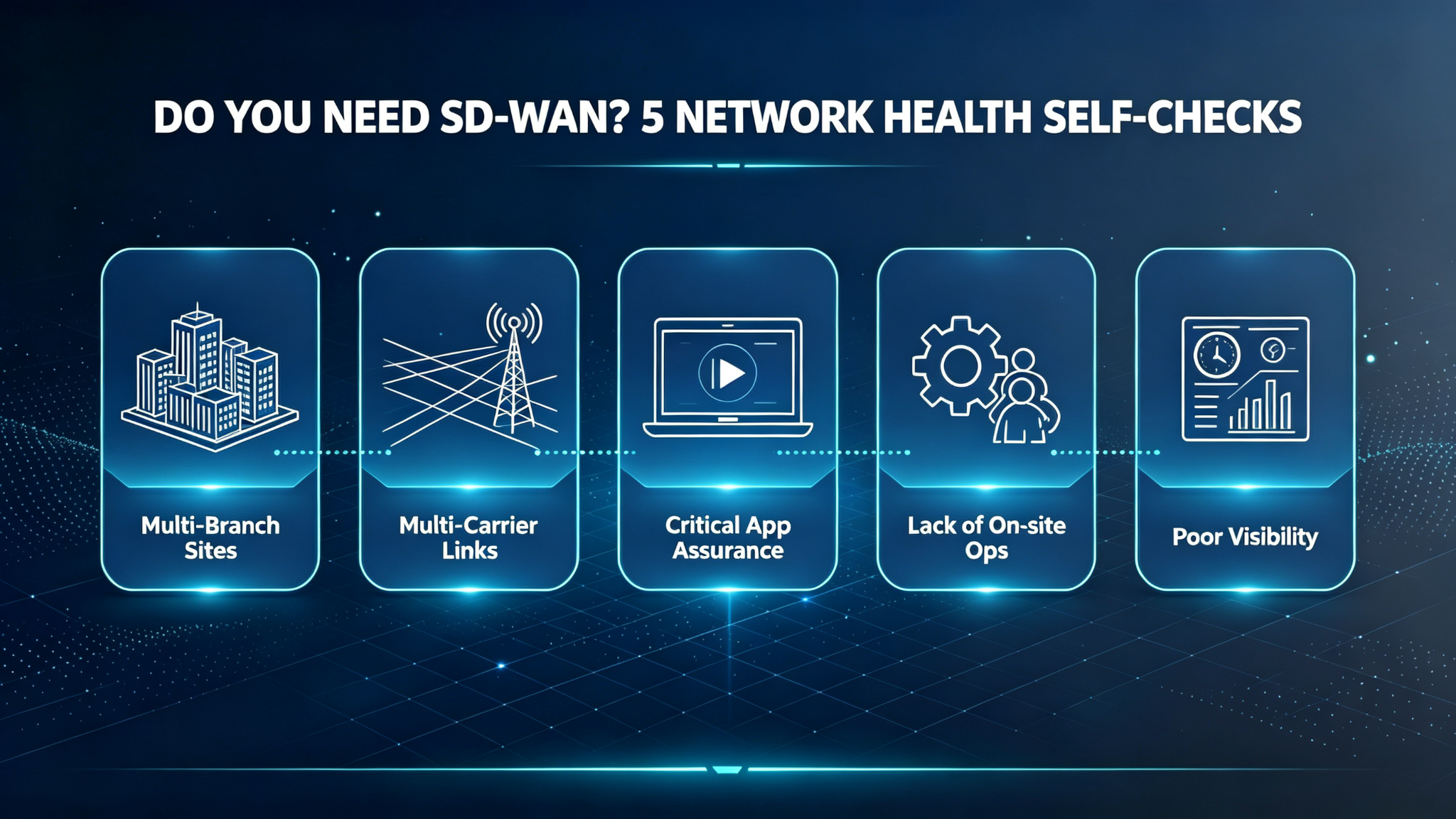
If your enterprise exhibits several of the following conditions, your current network architecture may no longer meet business needs, and it is advisable to seriously evaluate the suitability of SD-WAN:
If your enterprise has only one site with a simple network structure, the urgency for centralized management is limited. However, when the number of branches keeps increasing and each site needs uniform access to headquarters’ business platforms, policy consistency and centralized operations become core considerations.
Having multiple lines does not automatically mean efficient utilisation. If each line operates independently without unified status monitoring and traffic scheduling, you may still face the paradox of congestion on one link while others are underutilised. The value of intelligent path selection and link redundancy must be judged against actual line conditions.
Applications such as video conferencing, industrial IoT data collection, video surveillance backhaul, and ERP systems have varying sensitivity to latency and jitter. Enterprises should first identify key applications that directly affect business continuity, and then assess whether QoS and path‑selection policies are needed for targeted protection.
If new branch onboarding, policy adjustments, and fault diagnosis all require on‑site support from headquarters engineers, then branch growth will proportionally increase operational pressure. ZTP zero‑touch provisioning and remote centralized management can effectively reduce on‑site dependencies, but enterprises still need to establish clear processes for device, link, and policy management.
When network information is scattered across different devices and management interfaces, headquarters cannot quickly obtain real‑time operational status of each branch. If your enterprise desires unified visual management and centralised policy distribution, SD‑WAN’s visibility and centralised control capabilities offer clear practical value.
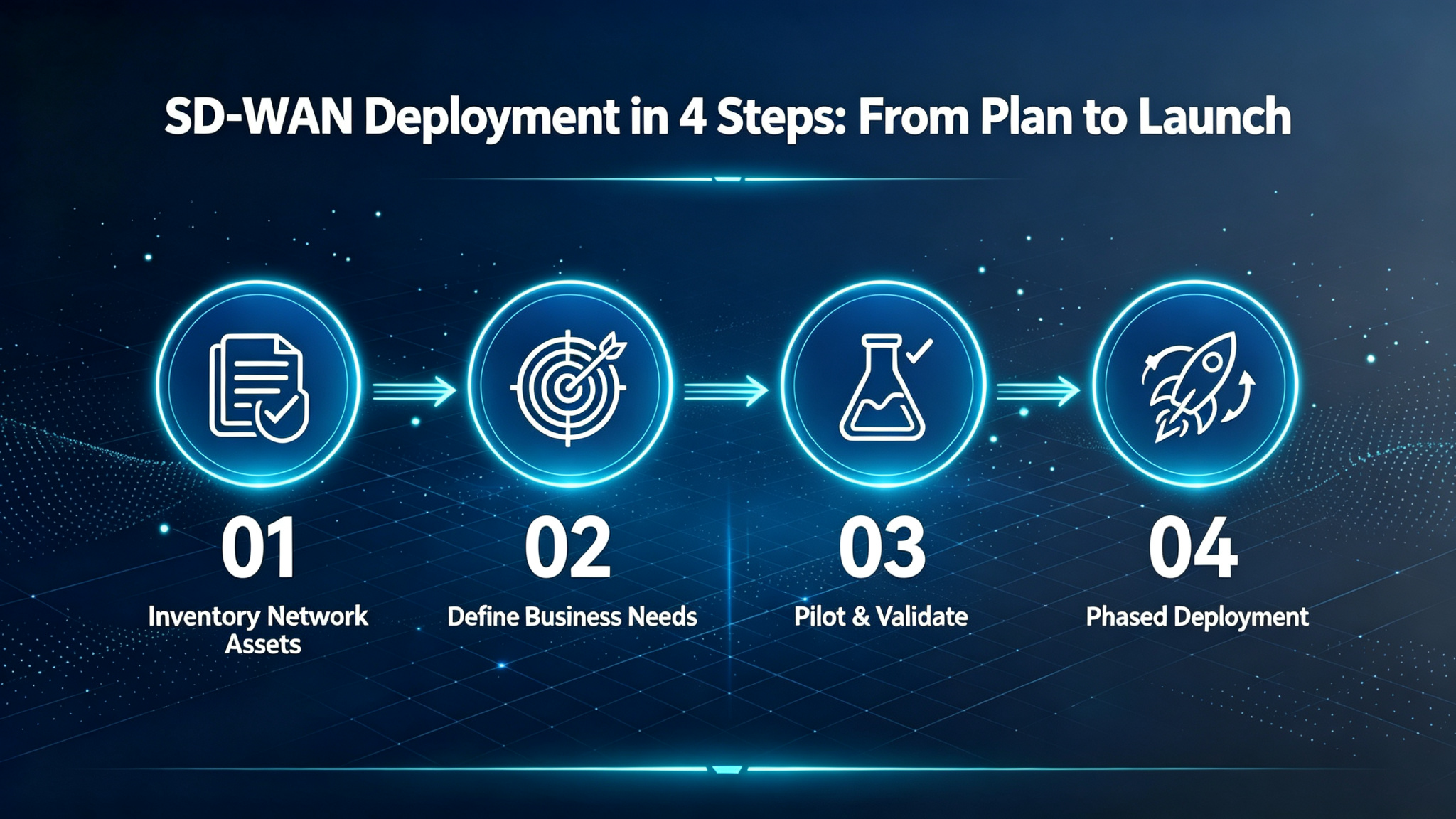
Deploying SD‑WAN is not merely replacing equipment. We recommend following this scientific, orderly process:
Thoroughly review the number of branches, carrier line contracts, current device models, critical application lists, and recent fault records. Only by fully understanding the current state can subsequent solution design focus on real issues, rather than purely technical substitution.
Determine which services should be prioritised, which branches require link redundancy, and which policy parameters headquarters wants to centrally control. Policy formulation should start from business needs, not just technical metrics.
Choose branches with typical network environments or business types, and thoroughly test link access quality, policy deployment effectiveness, improvements in critical application experience, and fault‑handling processes. During the pilot, systematically document encountered issues to accumulate experience for later rollout.
Based on pilot results, deploy in batches by branch type or region. Going live is not the end; continue to monitor network performance, and dynamically adjust traffic policies and operational processes as business evolves.
Taking the OgCloud SD-WAN enterprise networking solution as an example, the following types of domestic enterprises are benefiting:
1. Chain Restaurants / Retail: POS systems lagging during peak hours, causing long customer queues. With OgCloud’s dual‑link architecture (primary broadband + backup 4G/5G) and intelligent path selection, POS success rates reach 99.99%, and WAN expenses are cut in half.
2. Manufacturing Industrial IoT: Factory PLC equipment needs remote debugging, but traditional VPNs are complex and unstable. OgCloud uses Layer‑2 transparent transmission and zero‑downtime bypass deployment, requiring no changes to the existing industrial ring network, enabling remote engineers to perform operations in seconds.
3. Group‑Level ERP Interconnection: Branch offices experience extremely slow access to headquarters’ Yonyou/Kingdee/SAP systems. OgCloud provides protocol‑specific optimisation for ERP, reducing cross‑regional latency and greatly improving collaboration efficiency.
Not necessarily all of them. SD‑WAN deployment offers flexible approaches:
● Supports bypass deployment – SD‑WAN devices can be connected in parallel to the existing network without changing original routers, firewalls, or architecture, ensuring business continuity during deployment.
● Compatible with existing lines – Existing broadband, MPLS leased lines, and 4G/5G can all be retained; SD‑WAN supports hybrid networking and reuse of legacy assets.
● Gradual replacement at branches – Deploy dedicated SD‑WAN CPE devices at branch sites (replacing branch routers/firewalls) – headquarters often requires minimal changes. Later, you can transition gradually if needed.
Yes. Mainstream SD‑WAN solutions generally offer pre‑integrated support for major public clouds like Alibaba Cloud, Tencent Cloud, AWS, and Azure. The SD‑WAN centralised management platform can uniformly configure cross‑cloud access policies, avoiding the need to build separate connections for each cloud.
Yes. SD‑WAN CPE devices can connect through ordinary broadband. After power‑on, they automatically register with the cloud‑based controller and establish encrypted Overlay tunnels. Even if all branches only have standard broadband, they can interconnect via the SD‑WAN backbone POP nodes.
Yes, and it’s not expensive. When VPNs exceed 3 branches, operational overhead tends to grow invisibly. SD‑WAN devices are plug‑and‑play with cloud‑based unified management, eliminating the need for IT staff at each branch.
Control remains in your hands. SD‑WAN uses controller‑based centralised management plus customisable policies. Through the visual interface, enterprises can configure application priority, security policies, and QoS rules themselves – the vendor only provides the platform and operational support.
For multi‑branch enterprise networking, the theme in 2026 has shifted. The key to deciding whether SD‑WAN is worth deploying is not chasing technological buzzwords, but confirming whether it solves your current challenges in provisioning speed, link scheduling, and operations management.
We suggest using this “health checklist” to complete a current‑state network assessment. For tailored networking advice for your specific business scenarios, consult OgCloud for customised SD-WAN solutions.

International transportation + IT O&M outsourcing + self-owned backbone network

Cellular chips + overseas GPS + global acceleration network

Overseas server room nodes + dedicated lines + global acceleration network

Global acceleration network + self-developed patented technology + easy linking

Global Acceleration Network + Global Multi-Node + Cloud Network Integration