


全球IT供应链
国际运输+IT运维外包+自营骨干网
Chinese enterprises going global are entering a new AI-driven phase, yet the overseas deployment of AI infrastructure has become a bottleneck for many. According to a survey by 36Kr Research, 52.7% of AI-focused overseas enterprises face insufficient global computing infrastructure coverage, leading to high cross-regional service latency and poor data collaboration efficiency.
Meanwhile, AI-industry-related goods have become the fastest-growing segment of China's exports. From January to April 2026, AI-industry goods exports reached US$293.5 billion, accounting for 22% of China's total exports—a year-on-year increase of 39.6%, contributing 49% of the overall export growth. In the first half of the year, AI computing hardware imports and exports totaled RMB 5.13 trillion, up 56.6%. As hardware exports scale up rapidly, efficiently deploying IT equipment such as GPU servers, optical modules, high-speed cables, and edge computing nodes overseas—and turning them into usable infrastructure—has become a critical challenge.
Procurement of GPU servers, optical modules, and other hardware overseas involves long lead times and high costs. Export controls on high-end GPUs are tightening, making computing hardware both expensive and difficult to obtain.
High-value, sensitive equipment requires specialised logistics solutions that standard carriers cannot provide. Customs clearance procedures vary by country, and documentation or certification issues often cause weeks of delays at destination ports.
After equipment arrives, the lack of local engineers for installation and commissioning is a widespread problem. Hiring IT engineers locally is costly and time-consuming, directly impacting go-live schedules.
When equipment, cabling, logistics, and deployment are each handled by different parties, the overall timeline becomes unpredictable, and accountability is unclear when issues arise.
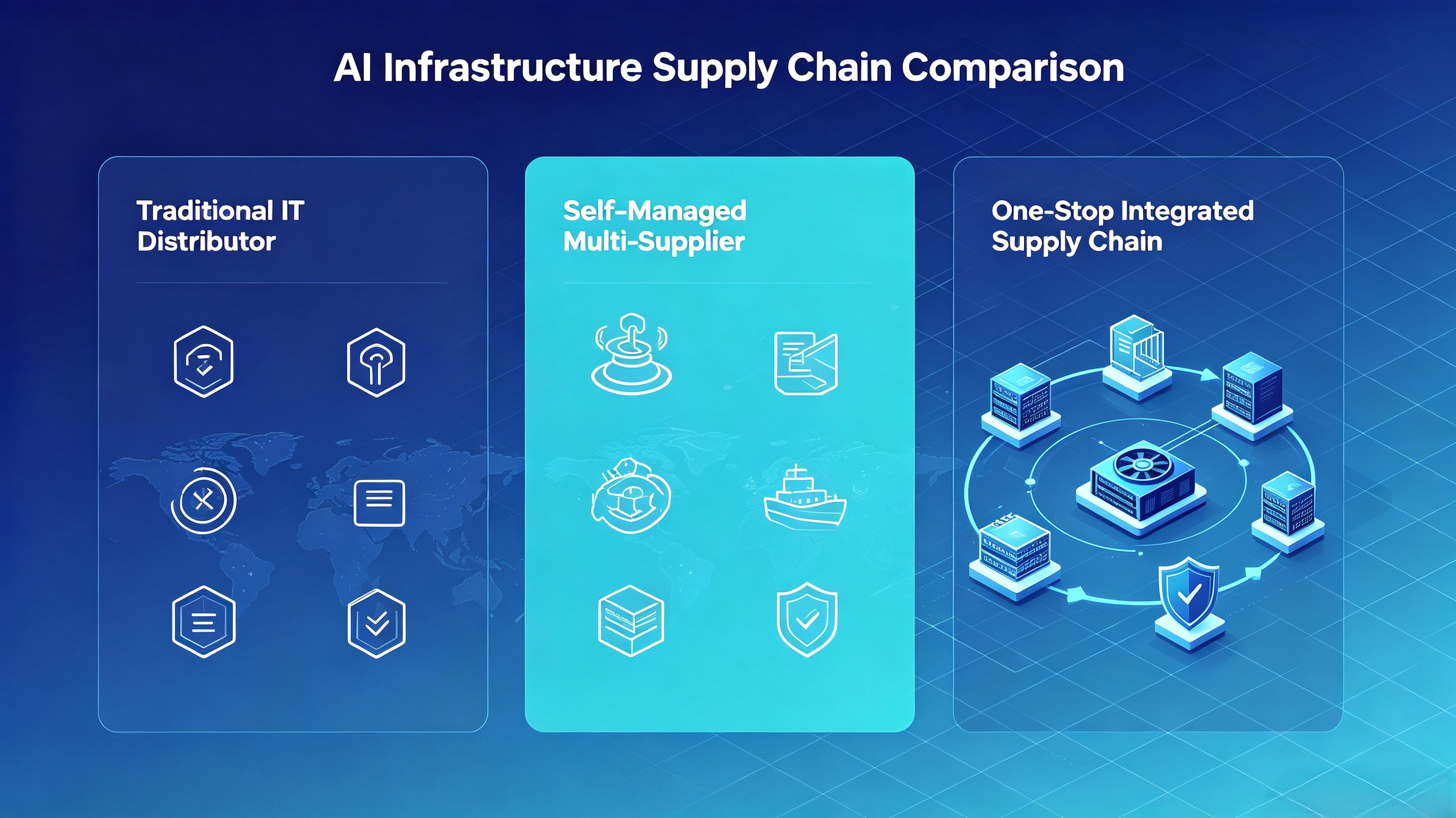
| Comparison Dimension | Traditional IT Distributor | Self-Coordinated Multi-Vendor | Integrated Supply Chain |
|---|---|---|---|
| Delivery Lead Time | Mature domestic channels, but overseas delivery timelines are uncontrollable | Relies on the enterprise's own coordination capability across all steps | Unified coordination, controllable lead time |
| International Logistics | Limited overseas logistics experience | Must engage local logistics and customs clearance on its own | Dedicated IT equipment logistics + customs clearance + insurance |
| Overseas Maintenance | No local maintenance team | Must hire locally or outsource | Local engineering team for on-site support |
| SLA Guarantee | Usually no explicit commitment | Inconsistent SLAs across parties | Unified SLA with single point of accountability |
| Best Suited For | One-off small-batch procurement | Companies with overseas presence and large volumes | Multi-batch, multi-region long-term deployments |
Each of the three models has its pros and cons, depending on the company's overseas stage and project scale. The so-called integrated supply chain model essentially consolidates hardware procurement, international logistics, and local deployment into one closed-loop. The enterprise only needs to interface with a single point of contact, while the service provider coordinates the entire process from factory dispatch to overseas go-live, and takes full responsibility for the final delivery. For multi-batch, multi-region long-term deployments, the integrated supply chain shows clear advantages in delivery predictability, logistics coverage, maintenance support, and SLA assurance—making it an effective way to reduce management overhead and delivery risks. Below, we look at how this model works in practice across different scenarios.
Demand for AI infrastructure deployment in hotspots like Southeast Asia, the Middle East, and Latin America is growing rapidly, and OgCloud has delivered actual projects in these markets. Here are a few representative cases.
Requirement:
An AI company planned to deploy a smart computing center infrastructure in Singapore, involving GPU server clusters, storage network switches, 800G/400G optical module interconnects, high-speed DAC/AOC cables, and structured cabling systems. As Southeast Asia's AI hub, Singapore demands extremely high delivery timelines and technical specifications.
OgCloud Solution:
The project covered centralized procurement and synchronized delivery of over 30 GPU servers and switches, plus more than 600 optical modules and cables. The local engineering team handled rack installation, deployment, and operational handover.
Outcome:
Synchronized delivery of servers, optical modules, and cables avoided compatibility issues from fragmented procurement. Data-center-grade structured cabling was completed in one go, enabling 800G data center interconnect.
Requirement:
An AI company needed to deploy AI inference edge nodes across three Southeast Asian countries to cover real-time image recognition and intelligent analytics. Edge deployments are characterised by multiple sites and fast pace—each site requires independent installation, commissioning, and network configuration.
OgCloud Solution:
Procurement of GPU edge servers, supporting high-speed optical modules and cables, international logistics, and on-site racking and commissioning locally.
Outcome:
Full-chain delivery from equipment procurement to inference go-live was completed in 2 weeks.
Requirement:
A large textile group built a long-term production base in Vietnam, requiring overall factory weak-current planning, server room construction, structured cabling, security and CCTV systems, and cross-border network interconnection among Vietnam, mainland China, and Hong Kong.
OgCloud Solution:
End-to-end delivery from solution design, equipment procurement, to local installation and construction.
Outcome:
Completed construction of two server rooms, full-factory weak-current planning, and tri-region cross-border network interconnection.
Requirement:
A network service provider needed IT equipment integration and delivery across multiple countries including Turkey, Mexico, and India.
OgCloud Solution:
Procured Dell servers, H3C switches, Fortinet firewalls, optical modules, and other equipment on behalf of the client; handled export applications and customs clearance; transported to destinations; completed local racking, installation, and commissioning; and provided local warranty maintenance.
Outcome:
Synchronised delivery across multiple sites in three countries, including local installation and three-year maintenance.
Export of high-end GPU servers is subject to export control regulations. Whether an export license is needed depends on the specific model, destination, and end-use. With over 10 years of hands-on experience in IT equipment overseas deployment, OgCloud can help assess export compliance risks and handle the necessary paperwork. We recommend confirming this prior to procurement to avoid shipment delays due to licensing issues.
It depends on project scale and product type. Small-batch local procurement overseas may be more convenient but often comes with significant price premiums. For large-volume, multi-batch procurement, unified domestic sourcing plus export generally lowers per-unit equipment costs, though logistics and customs costs must be added. The integrated supply chain advantage lies in bundling procurement, logistics, and customs into a single quoted price, giving enterprises a clear total-cost estimate upfront.
Local deployment only requires racking and commissioning, while overseas deployment adds international logistics, customs clearance, insurance, and compliance with destination-country regulations—significantly increasing complexity. Additionally, local power standards, network environments, and construction practices differ from those in China and must be adapted in advance.
AI training clusters demand extremely high compute density and inter-node interconnect bandwidth, typically using high-performance GPU servers paired with high-speed optical modules for low-latency connections. Inference nodes, by contrast, emphasise per-node cost-effectiveness and rapid scalability, with faster deployment cycles and more numerous sites.
Post-deployment maintenance is a blind spot for many companies. Some service providers have local engineering teams in major overseas markets, offering on-site racking, commissioning, and ongoing maintenance support with 24/7 multi-language response and SLA guarantees up to 99.99%.
The real barrier to AI infrastructure overseas deployment lies in synchronising procurement, logistics, and deployment—hardware arriving overseas does not mean usable computing power if there is no local team for installation, commissioning, and ongoing maintenance. The key is choosing the right model, with a single team accountable from start to finish.
With 12 years of hands-on experience in AI infrastructure overseas deployment, OgCloud covers 50+ countries and regions across Southeast Asia, the Middle East, Latin America, and Europe. For more information about our AI infrastructure overseas services, please visit our website: www.ogcloud.net.