


全球IT供应链
国际运输+IT运维外包+自营骨干网
As enterprises keep expanding branch offices, network managers often face a dilemma when choosing between SD-WAN and MPLS. MPLS leased lines deliver stable performance yet come with high costs and slow deployment. SD-WAN is flexible and cost-effective, but its performance relies heavily on the service provider’s backbone network. Fundamentally, choosing between the two means balancing cost, performance, flexibility and controllability. This article thoroughly analyzes the differences and respective strengths of SD-WAN and MPLS to help enterprises make optimal decisions.
SD-WAN (Software-Defined Wide Area Network) is a networking technology that manages and optimizes WAN performance based on SDN (Software-Defined Networking) principles. Its core technical features include: Overlay architecture (building a virtual network layer on top of underlying physical networks), intelligent path control (selecting the optimal link in real time based on application types), centralized orchestration (unified network policy management via controllers), and native NFV (Network Function Virtualization) support.
SD-WAN decouples the network control plane from hardware forwarding planes, and schedules cross-network traffic centrally via software. It supports hybrid access to multiple underlying links including broadband, private lines, 4G and 5G.
MPLS (Multiprotocol Label Switching) is a Layer 2.5 switching technology that forwards packets rapidly by label guidance. Its working mechanism: a fixed-length label is assigned to every IP packet at the network edge. Label Switching Routers (LSRs) within the core network make forwarding decisions solely based on labels, without parsing IP addresses hop-by-hop.
MPLS adopts the "route once, switch many times" logic: route lookup only occurs once at the network edge, and all forwarding across the core is completed via Label Switched Paths (LSPs). This drastically reduces per-hop processing overhead.
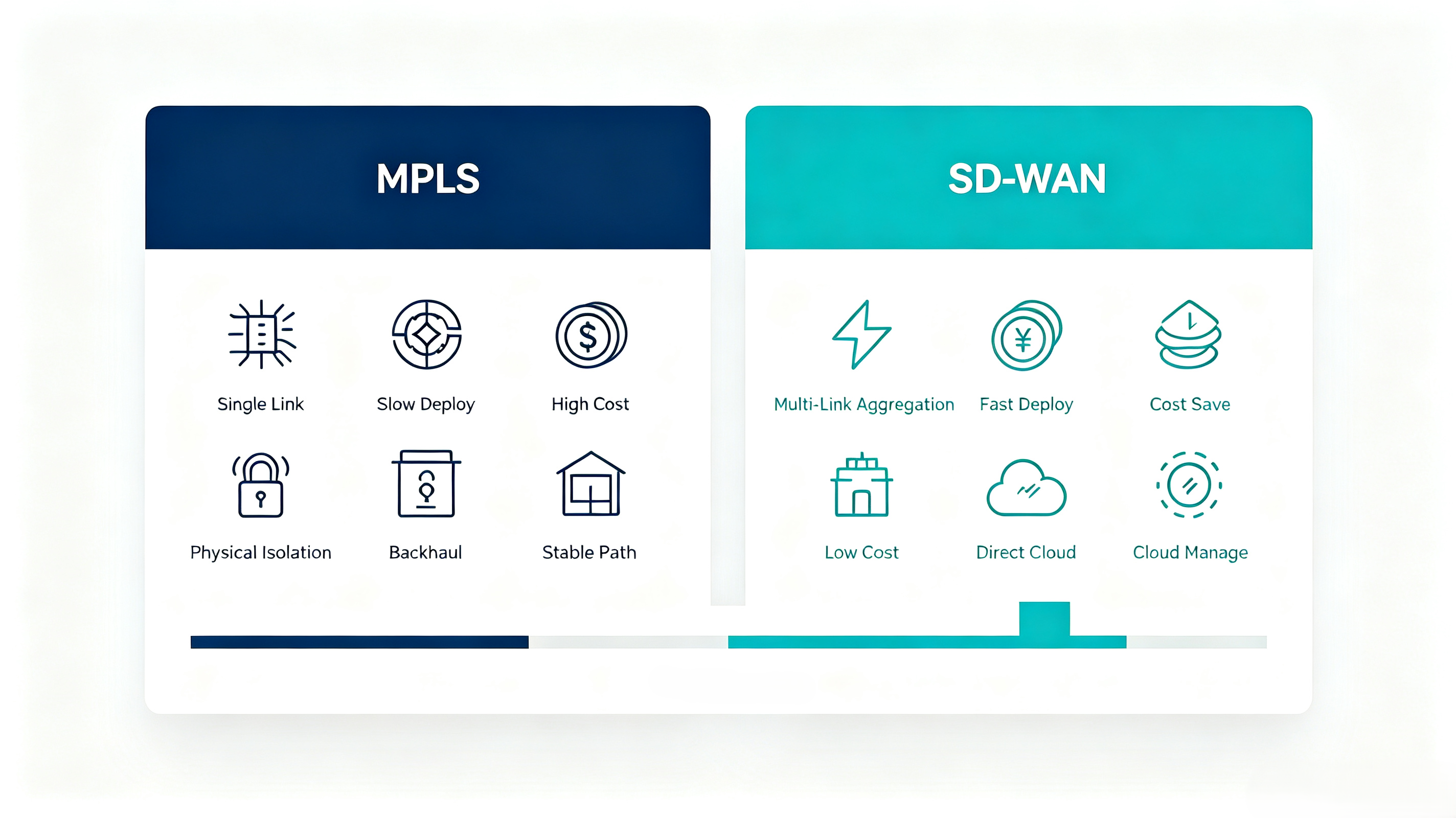
| Comparison Dimension | MPLS Leased Line | SD-WAN |
|---|---|---|
| Core Technology | Underlying transport technology, forwarding via labels | Intelligent scheduling overlay deployed on existing networks, centrally managing mixed link types via software |
| Supported Link Types | Single carrier private line only | Hybrid aggregation: broadband, private lines, 4G/5G, etc. |
| Overall Cost | High | Low; cuts total expenses by 30%–50% compared with MPLS |
| Deployment Speed | Slow; standard lead time 45–60 days | Fast with ZTP zero-touch provisioning; single branch online in 5 minutes, full group deployment within 1–7 days |
| Network Stability | Excellent; latency/jitter <5ms, packet loss <0.1% | Near private-line grade; latency <30ms with robust backbone, 99.99% SLA, failover within 0.5 seconds |
| Cloud Application Access | All traffic backhauls to HQ before reaching cloud, wasting 30%–50% bandwidth | Direct cloud/SaaS access via nearby POP nodes, eliminating backhaul detours |
| O&M Model | Passive maintenance, heavy reliance on carriers, limited enterprise self-management authority | Proactive cloud-native O&M; full network visibility via centralized dashboards, remote policy push, minimal on-site maintenance |
The essential distinction: MPLS is an underlying transport technology, while SD-WAN acts as an intelligent traffic scheduling overlay on top of existing networks. They are not mutually exclusive and can fully coexist and collaborate.
SD-WAN leverages low-cost public internet broadband to replace or reduce MPLS consumption. A mid-sized enterprise with 10 branches can cut total networking costs by 50% after fully migrating from MPLS to SD-WAN. Savings cover not only monthly circuit fees but also IT labor and business downtime losses.
In contrast, a single 10M MPLS line costs thousands monthly, and bandwidth upgrades require lengthy carrier application and approval processes.
Adding or modifying MPLS circuits requires carrier involvement, taking weeks or even months. SD-WAN supports Zero-Touch Provisioning (ZTP): edge devices auto-retrieve configurations once powered on, cutting branch launch time from 2–4 weeks down to 5 minutes. This deployment efficiency directly shapes business expansion speed for enterprises scaling multiple locations rapidly.
SD-WAN aggregates multiple link types simultaneously: broadband, private lines, 4G/5G. Bandwidth can be expanded instantly by adding extra links without carrier approval.
MPLS is locked to a single carrier’s private infrastructure; bandwidth upgrades require formal applications, unable to match fast-growing business demands.
SD-WAN dynamically selects the optimal transmission path based on application priority and real-time link quality: critical business traffic uses premium links, while general traffic runs on low-cost circuits.
Although MPLS supports basic traffic engineering (TE) for traffic allocation, its forwarding paths are statically configured. Adjustments rely on dedicated carrier management systems, lacking SD-WAN’s real-time adaptive capabilities.
SD-WAN branch sites access SaaS and public cloud services directly without backhauling all traffic to the central data center.
MPLS is architected for point-to-point inter-site connections rather than branch-to-cloud access. All internet traffic must first route back to headquarters, creating obvious performance bottlenecks in today’s cloud-first business landscape.
Network administrators monitor full-network status and push unified policies via a single console, drastically lowering IT operational burdens.
Traditional MPLS deployments require coordination with multiple carriers, without a unified monitoring and orchestration platform. Fault troubleshooting and configuration changes become cumbersome and time-consuming.
MPLS delivers consistent latency, jitter and packet loss guarantees via Label Switched Paths, with end-to-end jitter typically below 5ms. It fits latency-zero-tolerance scenarios including high-frequency financial trading, remote surgical operations and industrial automation control. MPLS reserves dedicated network paths and carrier-grade QoS for stability.
SD-WAN achieves near-private-line stability via multi-link steering and nearby POP offloading to avoid degraded public internet segments under normal conditions. However, its reliability may fall short of MPLS during extreme underlying link degradation or insufficient POP coverage from the service provider.
MPLS includes formal written service quality commitments, with priority bandwidth allocation for core applications via QoS. SD-WAN stability depends entirely on the provider’s backbone capacity, introducing uncertainties under severe network conditions.
MPLS data travels exclusively over the carrier’s private closed network, never traversing the public internet, which inherently blocks direct external cyberattacks.
While SD-WAN integrates VPN encryption, firewalls, intrusion detection and other security features, it operates over public internet infrastructure. Its security model shifts from "physical isolation" to "encryption + zero trust", requiring enterprises to maintain comprehensive security policy configurations.
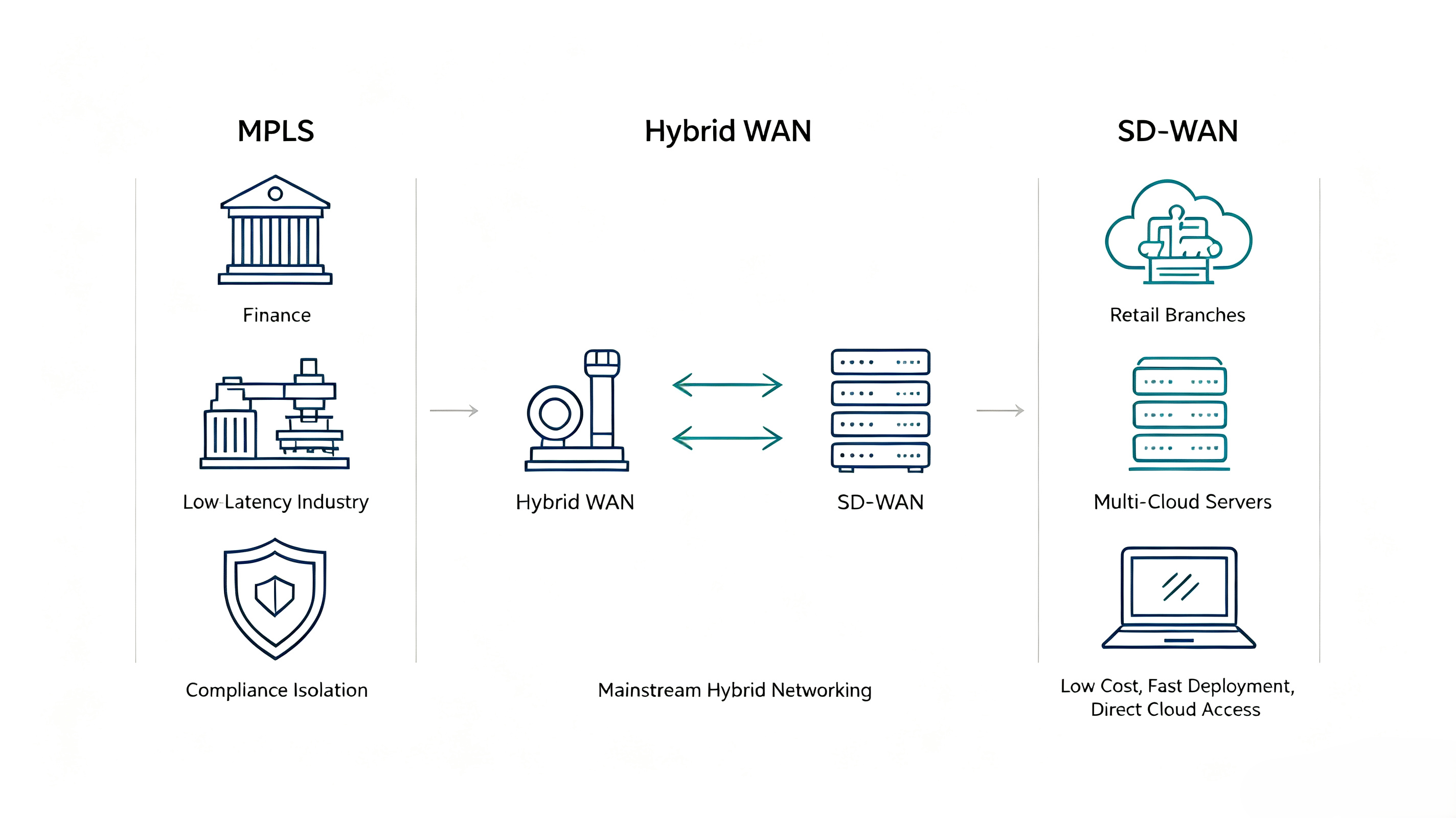
1. Latency-critical core workloads: high-frequency financial trading, remote surgery, industrial automation control
2. Regulated industries (finance, government) with compliance mandates requiring data transmission over physically isolated private circuits
3. Enterprises with large existing MPLS deployments where migration costs outweigh short-term benefits
1. Multi-branch enterprise wide-area networking
2. Cross-region connectivity for small and medium businesses
3. Retail chain and store branch networking
4. Enterprises adopting hybrid/multi-cloud strategies
Global SD-WAN market achieves a compound annual growth rate (CAGR) of 17.5%. Gartner forecasts that 60% of enterprises will deploy SD-WAN by 2026.Core driving factor: 85% of enterprise data no longer resides in traditional on-prem data centers, but distributes across cloud platforms and SaaS applications. MPLS’s backhaul-first architecture no longer aligns with cloud-native business operations.
Despite this clear trend, full replacement is not mandatory. MPLS remains irreplaceable for extreme use cases such as core financial trading and industrial control. Most enterprises adopt a hybrid WAN roadmap: retain MPLS for core production systems, while offloading edge branch and cloud-bound traffic to SD-WAN. MPLS has shifted from the default networking option to a niche specialized solution.
Against this industry backdrop, OgCloud SD-WAN delivers practical, production-ready solutions:
1. Underlying Link Optimization: Intelligent path algorithms continuously measure latency, jitter and packet loss across all links, dynamically steering critical business traffic to the best available path for near-private-line user experience
2. Carrier-Grade Availability Assurance: Multi-link redundancy plus sub-second failover delivers a 99.99% uptime commitment, matching the SLA standards of carrier private lines
3. End-to-End Integrated Security: Natively built-in encrypted transmission, zero-trust access architecture and next-generation firewalls embed full security capabilities into the network fabric
4. Universal Link Compatibility: Fully supports hybrid aggregation of broadband, private lines, 4G and 5G, flexibly adapting to diverse physical network conditions across branches
5. Centralized Visualized Orchestration: Unified single-pane management platform allows IT teams to monitor full-network health and roll out consistent policies remotely, drastically boosting operational efficiency
Whether you seek a smooth migration from legacy MPLS or a brand-new WAN architecture, OgCloud (www.ogcloud.net)provides customized professional solutions aligned with real-world business requirements.
Complete replacement will not happen in the short term. MPLS remains irreplaceable for workloads requiring physical-layer transport guarantees, such as core financial trading and industrial control. The prevailing industry consensus is hybrid WAN architecture: MPLS carries core production traffic, while SD-WAN handles edge branch and cloud access flows.
Deployment barriers are extremely low. SD-WAN operates on a site-based subscription model without large upfront capital expenditure, making it ideal for SMEs with limited budgets and small IT teams. Combined with ZTP zero-touch provisioning, routine maintenance can be handled by non-senior network engineers.
SASE (Secure Access Service Edge) is an advanced architecture that adds cloud-native security capabilities on top of SD-WAN. Gartner predicts that 60% of new SD-WAN purchases will integrate SASE by 2026. Simply put: SD-WAN solves the problem of "how to connect reliably", while SASE adds comprehensive security protection for "how to connect safely".
Not necessarily. Most SD-WAN solutions coexist with legacy network hardware, supporting phased rollout via virtual software or standalone edge appliances without full rip-and-replace overhauls. However, evaluate whether legacy hardware meets the computational demands of SD-WAN encryption and intelligent path steering; outdated hardware is recommended for simultaneous upgrades.
Minor additional bandwidth overhead is generated. SD-WAN edge devices send periodic probe packets (every few seconds) to measure link latency, jitter and packet loss, consuming only 1%–5% extra bandwidth with negligible impact on standard business traffic. For metered 4G/5G cellular links, lower probe frequency is recommended to conserve data usage.